


Utkalmani Pandit Gopabandhu Das
Syllabus: GS1/History
Context
- President Droupadi Murmu unveiled the statue of Utkalmani Pandit Gopabandhu Das in New Delhi.
About
- Pandit Gopabandhu Das (1877–1928), popularly known as Utkalmani (Gem of Odisha), was a prominent freedom fighter, social reformer, educationist, poet, and journalist from Odisha.
- Devoted to the service of the poor and social upliftment, he founded the Satyabadi Bana Vidyalaya at Sakhigopal to promote nationalist ideals through education.
- His relief work during the 1912 floods and the 1918 influenza epidemic earned him widespread public respect.
- He was elected to the Legislative Council in 1917 and actively participated in India’s freedom movement as a member of the Indian National Congress.
- He founded the Odia newspaper The Samaja in 1919, which became an important platform for promoting nationalism and public awareness.
- He also made significant contributions to Odia literature. His notable works include Abakasha Chinta, Go-Mahatmya, Nachiketa Upakhyana, Karakabita, Dharmapada, and Bandira Atmakatha, many of which were written during his time at Ravenshaw College.
Source: AIR
Universal Immunisation Programme
Syllabus: GS2/Health
Context
- According to a study by the Union Health Ministry, introducing the hexavalent (six-in-one) vaccine into India’s Universal Immunisation Programme could improve the efficiency of childhood immunisation programmes.
About
- A hexavalent vaccine is a combination that protects infants against diphtheria, tetanus, pertussis (whooping cough), Hepatitis B, polio, and Haemophilus influenzae type b (Hib) in a single injection.
- It eases the workload of frontline health workers, lowers cold-chain requirements, and saves caregivers’ time.
Universal Immunization Programme (UIP) of India
- India launched the EPI in 1978, which was later renamed as the Universal Immunization Programme (UIP) in 1985.
- The programme reaches about 2.9 crore pregnant women and 2.54 crore newborns every year.
- The UIP provides vaccines to newborns, children, adolescents and pregnant women for protection against 12 diseases.
- The vaccines given under UIP are:
- Bacillus Calmette-Guérin (BCG).
- Diphtheria, Pertussis and Tetanus (DPT).
- Tetanus and adult Diphtheria (Td).
- Bi valent oral polio vaccine (bOPV).
- Measles-Rubella (MR) vaccine.
- Hepatitis B (Hep B).
- Pentavalent — DPT + Hepatitis B + Haemophilus Influenzae type b (DPT + Hep B + Hib).
- Rotavirus Vaccine (RVV).
- Pneumococcal Conjugate Vaccine (PCV).
- Japanese Encephalitis (JE) Vaccine.
Source: TH
Three Common Medicines Classified as Carcinogenic by IARC
Syllabus: GS2/ Health
Context
- The International Agency for Research on Cancer (IARC) has classified three commonly prescribed medicines—hydrochlorothiazide, voriconazole, and tacrolimus—as Group 1 (Carcinogenic to Humans).
About
- Hydrochlorothiazide is commonly used to treat hypertension, Voriconazole is an antifungal medicine used to manage serious invasive fungal infections, while Tacrolimus is an immunosuppressant that prevents rejection of transplanted organs.
What Does IARC’s Group 1 Classification Mean?
- Group 1 indicates that there is sufficient scientific evidence that an agent can cause cancer in humans.
- It is a hazard classification, not a risk assessment.
- A hazard means an agent is capable of causing cancer under some circumstances.
- It does not estimate the likelihood that cancer will occur in a person taking a medicine at the prescribed dose, nor does it weigh the benefits of treatment against the potential risks.
International Agency for Research on Cancer (IARC)
- The International Agency for Research on Cancer (IARC) is the specialized, intergovernmental cancer research agency of the World Health Organization (WHO).
- Established: 1965
- Headquarters: Lyon, France
- IARC evaluates environmental, occupational, and lifestyle factors to identify preventable causes of human cancer.
- IARC Carcinogen Classifications:
- Group 1: Carcinogenic to humans (e.g., tobacco, asbestos, solar radiation).
- Group 2A: Probably carcinogenic to humans.
- Group 2B: Possibly carcinogenic to humans.
- Group 3: Not classifiable as to its carcinogenicity to humans.
Source: TH
Atal Mission for Rejuvenation and Urban Transformation (AMRUT)
Syllabus: GS2/Governance
In News
- The Parliamentary Standing Committee has asked the government to accelerate the sewerage and septage management projects under AMRUT 2.0, stating that only 104 out of 594 projects (17.5%) have been completed and 67% are in progress.
Atal Mission for Rejuvenation and Urban Transformation (AMRUT)
- It was launched in June 2015 to improve the quality of life in cities.
- It is a centrally sponsored scheme, with funds shared among States and UTs based on urban population and number of towns.
- It is aimed at providing basic services such as water supply, sewerage, urban transport, and parks.
- It focused on building infrastructure that delivers better services to people, especially the poor.
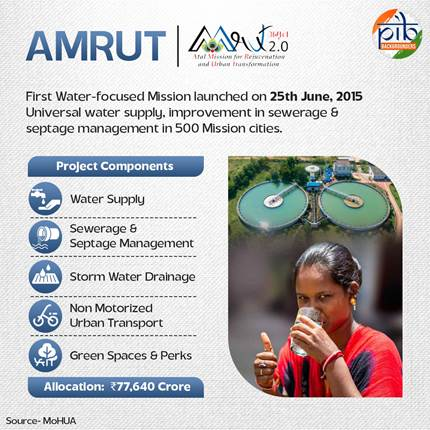
AMRUT 2.0
- It was launched on 1 October 2021. It covers all Urban Local Bodies (ULBs) and aims to make cities water secure and self-reliant.
- One key goal is to provide universal coverage of sewerage and septage management in the original 500 AMRUT cities.
Source: BS
10-km Mining Buffer Applies to All Wetland Reserves: SC
Syllabus: GS3/Biodiversity and Conservation
Context
- The Supreme Court has clarified that the 10 km radius buffer for mining extends to all wetland reserves in the country.
About
- The Asan Wetland Conservation Reserve lies at the confluence of the Asan and Yamuna rivers in Uttarakhand and was designated a Ramsar site in 2020.
- It is an important habitat for migratory waterbirds and supports rich aquatic biodiversity.
- The Supreme Court directed that no mining activity should be carried out within a 10-km radius of the reserve unless the project proponent first obtained permission from the Standing Committee of the MoEFCC.
- Wetland’s designation as a Ramsar site warranted heightened scrutiny of activities that could affect its ecological character.
- The latest clarification indicates that the same principle would apply to other wetland conservation reserves across India.
What is a Wetland?
- A wetland is an ecosystem in which the land is covered by water—salt, fresh, or somewhere in between—either seasonally or permanently. It functions as its own distinct ecosystem.
- It includes water bodies such as lakes, rivers, underground aquifers, swamps, wet grasslands, peatlands, deltas, tidal flats, mangroves, coral reefs, and other coastal areas as well.
- These wetlands can be classified into three segments such as inland wetlands, coastal wetlands, and human-made wetlands.
Wetlands in India
- India includes high-altitude wetlands of the Himalayas, floodplains of rivers such as Ganges and Brahmaputra, lagoons and mangrove marshes on the coastline, and reefs in marine environments.
- India has around 4.6% of its land as wetlands, 101 Wetlands of India are under the List of Wetlands of International Importance called as Ramsar Sites.
- India boasts the largest Ramsar site network in Asia and the 3rd largest in the world in terms of number of sites.
- Tamil Nadu holds the highest number of Ramsar sites in India in 2026 with 20 sites.
Ramsar Convention
- It is an international treaty aimed at conserving wetlands around the world. It was adopted in Ramsar, Iran, in 1971 and entered into force in 1975.
- Countries that are parties to the convention commit to designating wetlands of international importance within their territories. These sites are referred to as Ramsar Sites.
- Criteria:
- supporting vulnerable, endangered, or critically endangered species or
- threatened ecological communities or,
- if it regularly supports 20,000 or more waterbirds or,
- It is an important source of food for fishes, spawning grounds, and nursery.
- India has been a party to the Convention since 1982.
Source: TH
Better Pigeonpea Varieties
Syllabus: GS3/Economy
In News
- Indian Council of Agricultural Research (ICAR) has developed India’s first fully annotated telomere-to-telomere (T2T) reference genome of pigeonpea (Cajanus cajan L. Millsp.) variety ‘Asha’.
About
- It builds on India’s first pigeonpea draft genome (2011) and its improved version (2017).
- It will enable the development of high-yielding, climate-resilient, and nutritionally enriched pigeonpea varieties, thereby strengthening India’s food and nutritional security.
Do you know?
- Telomeres are repetitive DNA sequences at the ends of chromosomes that maintain the stability and integrity of chromosomes.
- They shorten with each division of a cell, and when they reach a critical length, the cells stop dividing.
- Their DNA is highly repetitive, so it is difficult to use conventional sequencing methods.
- Telomere-to-Telomere (T2T) Genome is a complete genome sequence without gaps from telomere to telomere with high accuracy.
- The T2T-CHM13 human genome resolved previously missing regions of the genome, such as repetitive DNA and centromeric regions.
- This will provide better insights into genetic variation, mutation, chromosome function, ageing, and disease, thus progressing precision medicine and genomics research.
Pigeonpea
- It is a major pulse crop cultivated extensively across the tropics and subtropics
- It is predominantly grown under rainfed conditions
- It is highly sensitive to erratic rainfall, poor seedling establishment, and moisture stress during germination.
- Global producers: Myanmar, Malawi, Kenya, Uganda, Haiti, Democratic Republic of Congo, and Nepal, etc.
- Major producing states of India: Uttar Pradesh, Madhya Pradesh, West Bengal, Bihar, Karnataka, and Jharkhand.
- Importance: It is popularly known as ‘Arhar’ or ‘Tur’ and is one of India’s most important pulse crops.
- It is renowned for its rich protein content and has long been a major dietary staple across the Indian subcontinent, providing vital nutrition to millions.
- It is a versatile and highly cherished legume that holds a special place in the diets of South Asian communities.
Mission for ‘Aatmanirbharta in Pulses
- The Government of India launched the Mission for ‘Aatmanirbharta in Pulses’ (2025-26 to 2030-31) to achieve self-sufficiency in pulse production
- It aims to reduce import dependence and enhance farmers’ income through improved seeds, area expansion, technology adoption, assured procurement, and strengthened post-harvest infrastructure.
- It aims to increase pulse production to about 35 million tonnes by 2030–31 through a comprehensive strategy involving research, seed systems, and extension services.
Source: PIB
ICAR Develops Indigenous Vaccine for African Swine Fever
Syllabus: GS2/Health
Context
- The Indian Council of Agricultural Research (ICAR) has developed India’s first indigenous MA-104 Cell Line-Based Live Attenuated African Swine Fever (ASF) Vaccine for pigs.
About
- The vaccine is recommended for healthy pigs above eight weeks of age and is administered as a 1 mL intramuscular injection, followed by a booster dose 14 days after the primary vaccination.
- The indigenous vaccine is expected to substantially reduce pig mortality, minimise economic losses and improve the livelihoods of pig farmers across the country.
African Swine Fever (ASF)
- African Swine Fever (ASF) is a highly contagious transboundary animal disease caused by the African Swine Fever Virus (ASFV), affecting domestic pigs and wild boar. It does not infect humans.
- First detected in Kenya in 1909, the disease is now found across Africa, Europe and Asia.
- Since its first detection in India in 2020, ASF has spread to several States and Union Territories, causing massive pig mortality, disruption of pig production, restrictions on animal movement and trade, and significant livelihood losses, particularly in the North-Eastern region.
- It spreads through direct contact with infected pigs, contaminated pork products, wild boar, and soft ticks.
- The disease is characterised by high fever, haemorrhages, and mortality rates that may approach 100%, making it one of the most devastating animal diseases affecting pigs.
Source: PIB
Previous article
Emerging Challenges Faced by the ISRO
